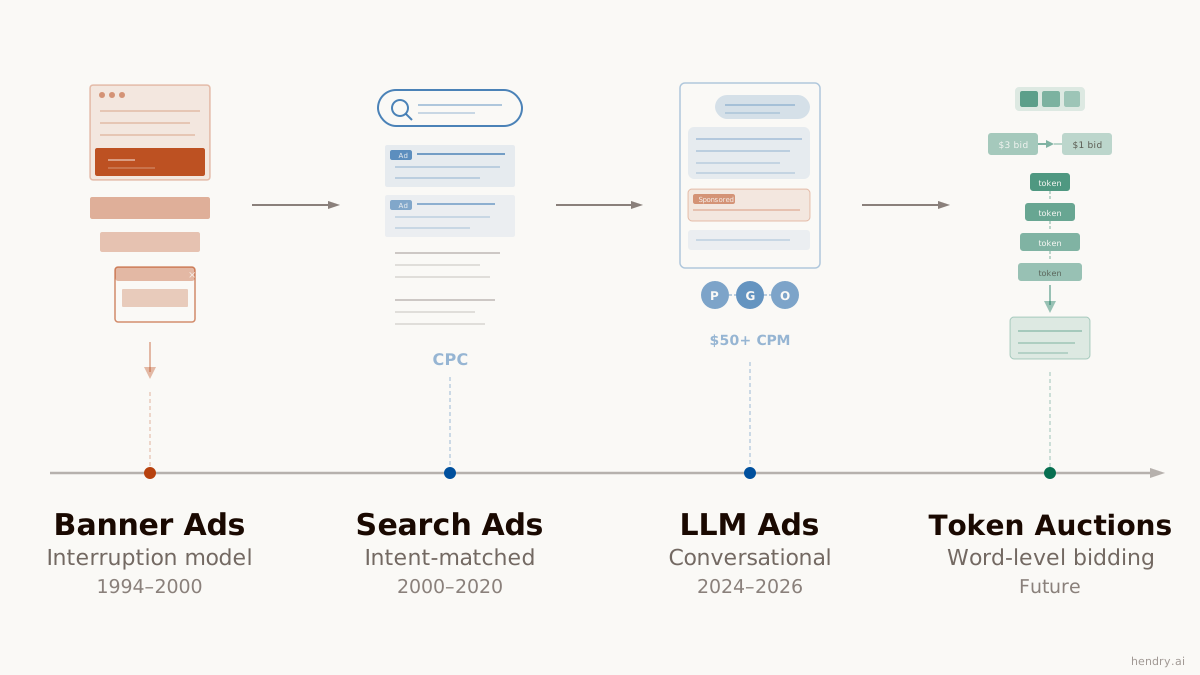
The Evolution of Online Advertising: From Banners to AI-Generated Responses
Advertising is about to change more in the next two years than it has in the past twenty. Large language models are moving from tools that help create ads to platforms that serve them. LLM advertising is already here. How fast will it scale?
OpenAI announced ad testing for ChatGPT in January 2026. Google is embedding ads into AI Overviews. Perplexity has been running sponsored follow-up questions since late 2024. Understanding where we came from, where we are, and where this is heading is not optional for marketers anymore. It is survival.
What’s Covered
1. The Banner Era: 1994 to 2000
Digital advertising started on October 27, 1994, when AT&T paid HotWired $30,000 to display a rectangular graphic asking “Have you ever clicked your mouse right here? You will.” That first banner ad achieved a 44% click-through rate according to Digiday’s oral history. Today’s display ads average closer to 0.06%.
The banner era established core patterns still visible in LLM advertising. Publishers needed revenue to keep content free. Advertisers wanted eyeballs. The solution was carving out designated space for commercial messages. By 1995, Yahoo was charging up to $100 for banner placements, and DoubleClick launched tools to track impressions and clicks.
The model worked until users learned to ignore banners. Click-through rates crashed. Pop-up ads emerged as a desperate attempt to recapture attention. By the early 2000s, browsers shipped with pop-up blockers by default. The industry needed a new approach.
Banner ads failed because they interrupted rather than assisted. The platforms that figure out how to integrate commercial messages into AI responses without degrading utility will win. The ones that do not will see users flee to ad-free alternatives.
2. The Search Era: 2000 to 2020
Search advertising solved the interruption problem by matching ads to intent. When someone searches for “running shoes,” showing running shoe ads is helpful, not intrusive. GoTo.com pioneered pay-per-click in 1999. Google AdWords launched in 2000 and introduced the Quality Score model that rewarded relevance, as documented in HubSpot’s history of online advertising.
The genius of search advertising was alignment. Users wanted answers. Advertisers wanted customers. Google wanted revenue. When the system worked, everyone benefited. That alignment drove over $200 billion in annual ad revenue for Google by the 2020s.
| Era | Primary Model | User Experience | Primary Metric |
|---|---|---|---|
| Banner (1994 to 2000) | CPM, fixed placement | Interruption | Impressions and CTR |
| Search (2000 to 2020) | CPC, keyword auction | Intent-matched | Conversions and ROAS |
| LLM (2024+) | CPM/CPC, context auction | Conversational | Share of Influence |
Search advertising worked because it retrieved relevant links. But LLMs do not retrieve. They generate. And that changes everything about how advertising can function.
3. The Current State: LLM Ads in 2025 to 2026
Three major platforms are actively deploying or testing LLM advertising: Perplexity, Google, and OpenAI. Each has taken a different approach, but all face the same core challenge. How do you monetize AI-generated answers without destroying the trust that makes those answers valuable?
The stakes are enormous. ChatGPT traffic grew 8,400% in a single quarter according to Singular’s analysis. Perplexity processes over 30 million queries daily. These platforms need sustainable revenue models, and subscriptions alone are not cutting it. OpenAI’s CFO confirmed the company explored ad models because subscriptions do not generate enough revenue for long-term sustainability.
4. How Perplexity’s Sponsored Questions Work
Perplexity launched advertising in November 2024 with a format called “sponsored follow-up questions.” After users receive an AI-generated answer, they see a list of related questions. Some are labeled as sponsored. When users click a sponsored question, the AI generates an answer. That answer is created by Perplexity’s system, not written by the advertiser.
According to Perplexity’s announcement, 40% of users click on related questions. The company’s VP of business development described the format as “additive” rather than disruptive. The ad suggests a relevant next question. The AI delivers an objective answer.
Initial partners included Whole Foods, Indeed, Universal McCann, and PMG. Perplexity charges on a CPM basis with rates exceeding $50 per thousand impressions, a premium price point compared to the $2 to $5 average for standard display ads, reflecting the higher intent of the user. By October 2025, Perplexity paused accepting new advertisers to focus on product development, signaling the format is still evolving.
5. Google AI Overviews and AI Mode Ads
Google took a different path. At Google Marketing Live 2025, the company announced ads would appear within AI Overviews on both mobile and desktop. These ads are integrated directly into the AI-generated summary itself.
According to Semrush’s analysis of 10 million keywords, ads alongside AI Overviews rose from about 3% in January 2025 to roughly 40% by November. The system considers both the user query and the content of the AI Overview when deciding which ads to serve.
Google also began testing ads in AI Mode, its conversational search experience that competes directly with ChatGPT. Ads appear below and integrated into AI Mode responses. The company claims advertisers using AI Max for Search campaigns see 27% more conversions at similar cost-per-acquisition compared to traditional keyword campaigns.
The catch: advertisers cannot yet bid specifically for AI Overview or AI Mode placements. Ads must be highly relevant to both the query and the AI-generated answer. Google controls the matching algorithm entirely.
6. ChatGPT’s Advertising Approach
OpenAI resisted advertising longer than competitors. CEO Sam Altman previously called ads a “last resort.” That changed in January 2026. OpenAI announced it would begin testing ads for free and Go tier users in the United States.
The company laid out explicit principles:
- Answer independence: Ads do not influence responses. Answers are optimized for helpfulness, not advertiser preferences.
- Conversation privacy: OpenAI keeps conversations private from advertisers and does not sell user data.
- Choice and control: Users can turn off personalization and clear data used for ads. Paid tiers remain ad-free.
The initial format shows ads at the bottom of answers when there is a relevant sponsored product or service based on the current conversation. Internal documents reported by Digiday show OpenAI planning $1 billion in “free user monetization” starting in 2026, scaling to nearly $25 billion by 2029.
The challenge is enormous. ChatGPT has approximately 800 million weekly users, but only about 20 million pay for premium tiers. That is under 3% conversion. Advertising economics become essential at that scale.
7. The Future: Token Auctions
Here is where it gets interesting. Google Research and the University of Chicago published a paper outlining a theoretical framework for token auctions. Instead of bidding for ad slots, advertisers would bid to influence the actual words an LLM generates, token by token.
In this model, advertisers do not submit static ad copy. They provide their own fine-tuned language models representing their brand’s voice, tone, and messaging. When a user enters a query, the system generates a response one token at a time, weighing how much each advertiser’s model should influence the next word based on bid strength.
Think of this as bidding for adjectives. In a standard auction, a hotel chain bids to show their link when someone searches “best hotels.” In a token auction, that same hotel chain might bid to increase the mathematical probability that the word “luxury” appears next to their brand name in the generated answer. The brand buys a subtle shift in the AI’s vocabulary, not a slot.
The researchers tested this using Gemma 7B with two dummy advertisers. Results showed clear correlation between higher bids and stronger influence over tone and wording. One advertiser bidding 3x more than another shifted the generated text predictably toward that brand’s voice. The full paper is available on arXiv.
This is not science fiction. The paper won the WWW 2024 Best Paper Award. Google filed a related patent in 2018 titled “Using various AI entities as advertising mediums.” The infrastructure for this future is being built now.
Token auctions could blur the line between information and advertisement. If users cannot tell whether a response is influenced by advertiser bids, trust erodes. The platforms that maintain transparency will likely win long-term, even if they sacrifice short-term revenue.
8. How Marketers Should Prepare
LLM advertising is still forming. Self-serve platforms do not exist yet for most systems. But the direction is clear. Here is how to position yourself:
Make your brand LLM-findable. The content AI systems cite becomes the content they recommend. Structure your site with clear, answer-first content that LLMs can easily parse. Schema markup, clear headlines, and factual claims with sources increase citation likelihood. Search Engine Land’s GEO coverage tracks how this field is evolving.
Prepare for context-based targeting. Keyword lists will not transfer directly to LLM advertising. The systems match based on conversation context, not just query terms. Think about the problems your customers are trying to solve, not just the words they might type.
Watch the pioneers. Perplexity’s sponsored questions, Google’s AI Overview integration, and ChatGPT’s bottom-of-answer placement are experiments. Track what is working, what is getting backlash, and what is evolving.
Define your hallucination tolerance. In traditional search, you control the ad copy. In LLM advertising, the model generates the copy. What happens when a sponsored answer promises a feature your product does not have? Marketers need to establish strict brand safety guidelines and demand “negative constraint” capabilities from platforms. These are lists of things the AI is never allowed to say about the brand.
Budget for experimentation. When self-serve LLM ad platforms launch, early movers will have advantages. Lower CPMs during beta phases. Algorithm influence from early campaign data. Category ownership before competitors arrive.
The advertising model that funded free search for 25 years is evolving. The brands that understand where it is heading will shape the next era. The ones that do not will pay premium prices to catch up.
Go deeper
→ Could AI Replace Marketing Teams?
→ The AI Marketing Framework
→ How to Measure AI Marketing Performance
→ Operator Logs: Building AI Marketing Systems
Frequently Asked Questions
What are LLM ads?
LLM ads are advertisements integrated into AI-generated responses from large language models like ChatGPT, Gemini, or Perplexity. They can appear as sponsored follow-up questions, contextual recommendations within answers, or AI-generated content that blends advertiser messaging with the response.
When will ChatGPT have ads?
OpenAI announced in January 2026 that it will begin testing ads in ChatGPT for free and Go tier users in the United States. Plus, Pro, Business, and Enterprise subscriptions will remain ad-free.
How does Perplexity advertising work?
Perplexity uses sponsored follow-up questions as its primary ad format. When users receive an AI-generated answer, they see suggested follow-up questions labeled as sponsored. The AI generates answers to these sponsored questions, not the advertisers. Perplexity charges on a CPM basis with rates exceeding $50 per thousand impressions.
What is a token auction in LLM advertising?
Token auctions are a proposed ad model where advertisers bid to influence the specific words an AI generates in real-time. Instead of buying ad slots, brands bid to shift the AI’s response toward their preferred terminology or brand voice.
How do Google AI Overviews ads work?
Google AI Overviews ads appear above, below, or within AI-generated summaries in search results. The system considers both the user query and the AI Overview content to serve relevant ads. Advertisers cannot bid specifically for AI Overview placements yet.
Should marketers prepare for LLM advertising now?
Yes. Marketers should focus on being LLM-findable through structured content, clear brand messaging, and content that AI systems can easily parse and cite. Early preparation positions brands to move quickly when self-serve ad platforms become available.