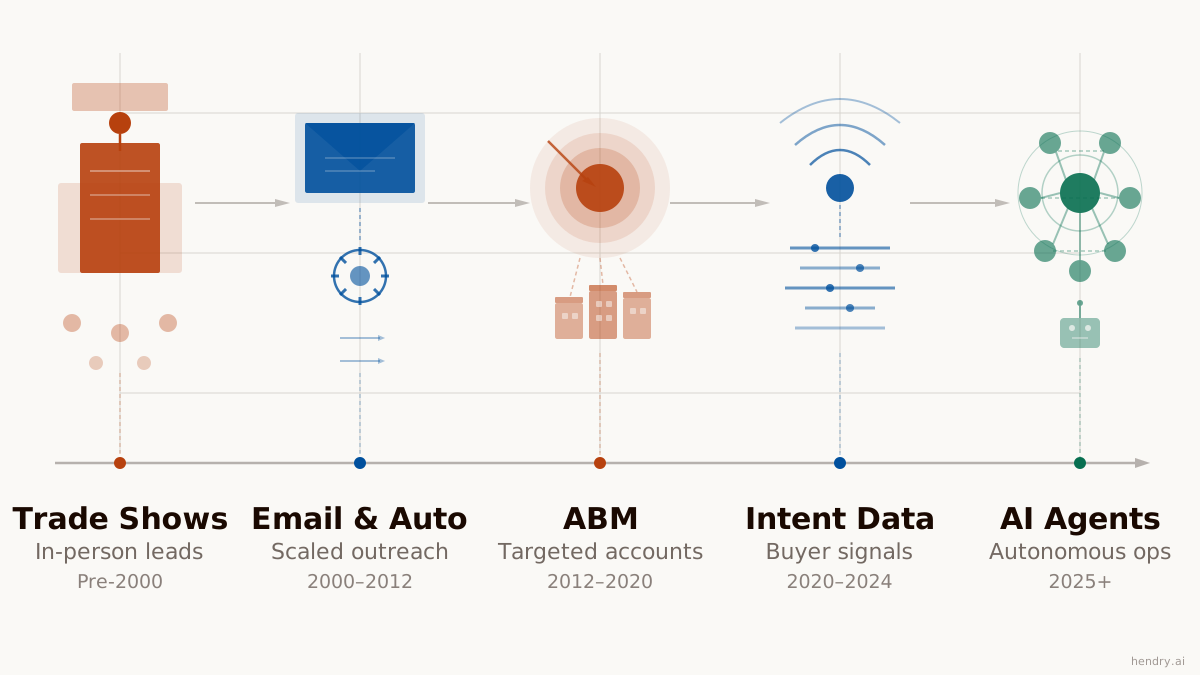
AI Demand Generation: From Trade Shows to AI Agents
Demand generation is about to change more in the next two years than it has in the past twenty. AI agents are moving from tools that support campaigns to systems that run them. The question is no longer whether AI will transform how B2B companies create pipeline. The question is how fast.
Gartner’s 2025 AI in Marketing Outlook projects over 70% of enterprise marketers will deploy some form of predictive orchestration by 2026. This represents a phase change, not gradual evolution. Understanding where we came from, where we are, and where this is heading has become a survival requirement for B2B marketers.
What’s Covered
1. The Trade Show Era: Pre-2000
Before the internet, B2B demand generation was fundamentally manual. Trade shows, print advertising, direct mail, and field sales were the primary channels. Information about products lived inside companies. Buyers had no independent way to research solutions.
The term “demand generation” did not exist. Marketers created fliers, brochures, and trade publication advertisements. They designed booth displays for conventions. The closest thing to lead capture was the “bingo card,” where readers circled numbers on magazine inserts to request product information.
According to the Content Marketing Institute, John Deere’s “The Furrow” magazine, launched in 1895, represents one of the earliest examples of content marketing. The publication educated farmers on new technology and business practices rather than directly selling equipment. This content-first approach would eventually become a cornerstone of modern demand generation, but it took a century for the rest of B2B marketing to catch up.
The fundamental constraint of this era was information asymmetry. Companies controlled all product knowledge. Buyers depended on salespeople to learn about options. This created a sales-led motion where demand generation meant putting salespeople in front of prospects, whether at trade shows, through cold calls, or via referral networks.
2. The Email Marketing Era: 2000 to 2006
Email changed everything. For the first time, marketers could reach thousands of prospects at near-zero marginal cost. The shift from direct mail to email was not just a channel change. It was an economic transformation.
The CAN-SPAM Act of 2004 established baseline compliance standards, introducing mandatory opt-out mechanisms. This was the first major regulation that forced marketing platforms to build compliance features. It laid the groundwork for future privacy laws that would reshape the industry.
According to CB Insights research, Eloqua was founded in 1999 as the first comprehensive marketing automation platform, originally conceived as a chatbot before pivoting based on customer feedback about tracking buying signals. This pivot from chatbot to marketing automation shows how customer input shaped the industry’s direction from the beginning.
| Era | Primary Model | Lead Source | Primary Metric |
|---|---|---|---|
| Trade Show (Pre-2000) | Field presence | Bingo cards, booth scans | Leads collected |
| Email (2000 to 2006) | Batch and blast | List purchases, web forms | Open rates, clicks |
| Automation (2006 to 2012) | Nurture sequences | Inbound, gated content | MQLs, conversion rates |
| ABM (2012 to 2020) | Account-centric | Target account lists | Account engagement, pipeline |
| Intent (2020 to 2024) | Signal-based | Third-party intent, behavior | In-market accounts, influenced revenue |
| AI (2025+) | Predictive orchestration | AI-identified signals | Predicted pipeline, conversion velocity |
Email marketing worked until it did not. Click-through rates crashed as inboxes overflowed. Spam became a household word. By the mid-2000s, marketers needed more than broadcast capability. They needed intelligence.
3. The Marketing Automation Era: 2006 to 2012
2006 was the watershed year. HubSpot, Marketo, and Pardot all launched, establishing the foundations of modern marketing automation. These platforms introduced concepts that still define B2B marketing: lead scoring, nurture sequences, and the marketing qualified lead (MQL).
SiriusDecisions created the Demand Waterfall in 2002, which became the industry standard for measuring return on marketing investment. The model established stage-based progression from inquiry through MQL to sales qualified lead to close. For the first time, marketing had a framework to connect activity to revenue.
The genius of marketing automation was alignment with buyer behavior. Instead of broadcast messages, marketers could respond to actions. A whitepaper download triggered one nurture stream. A pricing page visit triggered another. Behavior indicated intent.
According to Act-On’s analysis, the years 2010 to 2018 saw massive consolidation: Oracle acquired Eloqua for $871 million in 2012, Salesforce purchased ExactTarget (which owned Pardot) for $2.5 billion in 2013, and Adobe bought Marketo for $4.5 billion in 2018. The marketing automation category had arrived.
But the MQL model had a fundamental flaw. Sales teams sold to accounts, not leads. A single contact downloading a whitepaper meant little if the buying committee had six other members who never touched marketing content. The gap between marketing’s lead-based view and sales’ account-based reality created perpetual misalignment.
4. The ABM Era: 2012 to 2020
Account-based marketing existed as a concept since 2004 when ITSMA’s David Munns coined the term. But it took a decade for the technology to catch up. Demandbase and Engagio, both co-founded by former Eloqua executives, built the first ABM platforms that let marketers target accounts rather than individual leads.
The premise was simple: stop treating all leads equally. Focus resources on accounts that match your ideal customer profile. Surround buying committees with personalized messaging. Measure engagement at the account level, not the lead level.
Demandbase’s analysis describes ABM as the shift from “demand generation built around automated email and the marketing qualified lead” to a world where “sales teams were rightly focused on selling to accounts, not leads.” The platform shift reflected how B2B buying worked in practice.
ABM required a new tech stack: account identification, intent data, personalization engines, and cross-channel orchestration. It also required organizational change. Marketing and sales had to agree on target account lists. They had to share data. They had to measure the same outcomes.
By 2020, ABM had matured from marketing program to company-wide motion. But it still relied on marketing to identify which accounts to pursue and when. The next evolution would automate that decision.
5. The Intent Data Era: 2020 to 2024
Intent data flipped the model. Instead of marketers deciding which accounts to target, behavioral signals revealed which accounts were already in-market. Content consumption patterns, search behavior, technology installations, and hiring trends indicated buying readiness.
Platforms like Bombora, G2, and TrustRadius aggregated intent signals across thousands of websites. When an account’s research activity spiked on relevant topics, sellers received alerts. The promise was to engage buyers at the exact moment they started looking for solutions.
According to Forrester’s 2026 B2B Marketing Predictions, intent data has been a cornerstone of modern B2B marketing, helping brands understand when prospects are in-market or actively researching. Forrester’s 2025 Buyers’ Journey Survey found that 89% of B2B buyers now use generative AI somewhere in their procurement cycle, with 95% planning to integrate AI into purchasing workflows.
The limitation of third-party intent data is attribution. When an account researches “marketing automation” across the web, you know they are in-market. You do not know if they have heard of your solution. Intent reveals timing but not preference. The gap between “researching the category” and “considering your product” remained significant.
The other limitation was reactivity. Intent data captured signals that already happened. By the time a surge score triggered an alert, competitors with faster systems might have already engaged the account. The next evolution would anticipate intent before it manifested.
6. The Current State: AI Demand Gen in 2025 to 2026
We are now in a transition period. AI has moved from augmenting demand generation to fundamentally reshaping it. Three shifts define the current moment.
First, buyer research has compressed. According to McKinsey’s 2025 State of AI report, AI-powered content support for marketing strategy ranks among the top three use cases organizations report implementing. Buyers now start their research much earlier, using AI to instantly curate relevant insights. The middle of the funnel is compressing as prospects reach shortlists faster, armed with AI-compiled summaries.
Second, predictive intent is replacing observed intent. Gartner’s Strategic Predictions for 2026 forecasts that by 2028, 90% of B2B buying will be AI agent intermediated, pushing over $15 trillion of B2B spend through AI agent exchanges. AI agents can now analyze sales calls, forecast pipeline with greater accuracy, and recommend next-best actions to close deals faster. The technology exists to predict which accounts will enter buying cycles before they show traditional intent signals.
Third, AI agents are handling execution. Platforms like Warmly, Clay, and others offer AI marketing ops agents that automatically turn buyer signals into coordinated marketing actions across channels in real-time. The agent identifies the signal, selects the response, and executes the touchpoint without human intervention.
Gartner’s CMO Survey reports that marketing organizations are restructuring teams to prioritize strategy and innovation over execution. Gartner’s 2025 CMO Spend Survey found that 81% of marketing technology leaders are either piloting or have already implemented AI agents in their organizations, with GenAI investments delivering ROI through improved time efficiency (49%) and cost efficiency (40%). The economics have shifted decisively.
7. The Future: Autonomous Demand Platforms
The next phase is already visible. Autonomous Demand Platforms (ADPs) combine predictive analytics, machine learning, and large language models trained on historical engagement data. They interpret buyer signals to anticipate future actions and execute responses without human intervention.
According to Forrester’s 2026 B2B Predictions, decision-making will shift from human interpretation to AI-generated recommendations with confidence scoring and scenario simulation. The marketer’s role changes from campaign operator to system architect.
6sense’s 2025 B2B Buyer Experience Report reveals that buyers delay contact until two-thirds of the way through their journey and initiate outreach themselves over 80% of the time. High-performing teams use what practitioners call the “Sandwich Model,” where AI handles data aggregation and segmentation while humans shape strategy and final decisions. Winning organizations anchor ABM around a dynamic, jointly owned Target Account List that evolves continuously based on fit, behavior, and real-time buyer signals.
The implications are significant. Volume-based metrics like MQLs lose relevance when AI can identify which specific accounts will convert. Lead scoring becomes unnecessary when the system already knows which signals predict purchase. Campaign creation shifts from building sequences to defining constraints and objectives.
Autonomous systems create accountability questions. When an AI agent sends a message that damages a customer relationship, who is responsible? When predictive models create bias toward certain account types, how do you detect and correct it? The companies that figure out governance will win. The ones that deploy autonomous systems without guardrails will face consequences.
8. How Marketers Should Prepare
The autonomous demand generation era is not a distant future. Gartner projects it for 2026. That is one budget cycle away. Here is how to position yourself.
Build signal infrastructure first. AI systems are only as good as the signals they can access. Consolidate first-party intent signals, CRM data, and consent-based enrichment into a unified data layer. Without clean signal data, predictive models will fail.
Shift metrics from volume to velocity. MQL counts matter less than conversion velocity and influenced revenue. Track how fast accounts move through stages, not how many enter the top of funnel. AI optimization needs outcome metrics to learn from.
Prepare for compressed buyer journeys. When buyers research via AI search, they reach shortlists faster. Your content must be AI-findable. Structure site content with clear, answer-first information that AI systems can parse and cite. LLM advertising is already here, with implications for how brands appear in AI-generated responses.
Design for human-AI collaboration. The 2026 demand gen team will not be larger. It will be different. Strategy, creative intelligence, and system architecture become more valuable. Campaign execution and data analysis become automated. Restructure roles now rather than reactively.
Start with predictive scoring. You do not need to deploy autonomous agents immediately. Begin by adding predictive lead scoring to your existing CRM. Learn which signals predict conversion in your specific market. Use that learning to inform more autonomous systems later.
The demand generation model that funded B2B growth for two decades is evolving. The brands that understand where it is heading will shape the next era. The ones that do not will pay premium prices to catch up.
Limitations
- AI demand generation tools are evolving rapidly. Specific platform capabilities may change between publication and reading.
- Predictive accuracy varies significantly by industry, deal size, and data quality.
- Autonomous systems require significant data infrastructure investment before delivering value.
- Regulatory frameworks for AI-driven marketing are still developing.
Explore the AI Marketing System
→ Could AI Replace Marketing Teams?
→ The AI Marketing Framework
→ How to Measure AI Marketing Performance
→ Operator Logs: Building AI Marketing Systems
Frequently Asked Questions
What is demand generation?
Demand generation is the practice of creating awareness and interest in a company’s products or services through targeted marketing programs. It encompasses the full funnel from initial awareness through qualified pipeline, combining marketing programs with structured sales processes.
What is the difference between demand generation and lead generation?
Lead generation focuses on capturing contact information from potential buyers. Demand generation is broader, creating market awareness and nurturing interest across the full buyer journey. Lead gen is a tactic within demand gen, not a replacement for it.
When did marketing automation start?
Eloqua launched in 1999 as the first comprehensive marketing automation platform with lead scoring and tracking capabilities. The category expanded significantly in 2006 when HubSpot, Marketo, and Pardot all launched, establishing the foundations of modern marketing automation.
What is account-based marketing (ABM)?
Account-based marketing is a B2B strategy that concentrates resources on a set of target accounts, using personalized campaigns designed to engage each account based on their specific attributes and buying signals. It treats individual accounts as markets of one.
What is intent data in B2B marketing?
Intent data captures signals that indicate a prospect is researching a particular topic or solution. This includes content consumption patterns, search behavior, technology installations, and hiring trends. Intent data helps prioritize accounts showing active buying signals.
How will AI change demand generation?
AI is shifting demand generation from reactive lead capture to predictive buyer engagement. AI agents can identify intent signals before buyers self-identify, personalize outreach at scale, and orchestrate multi-channel campaigns autonomously. By 2026, leading teams will use AI to anticipate buyer needs rather than just respond to them.