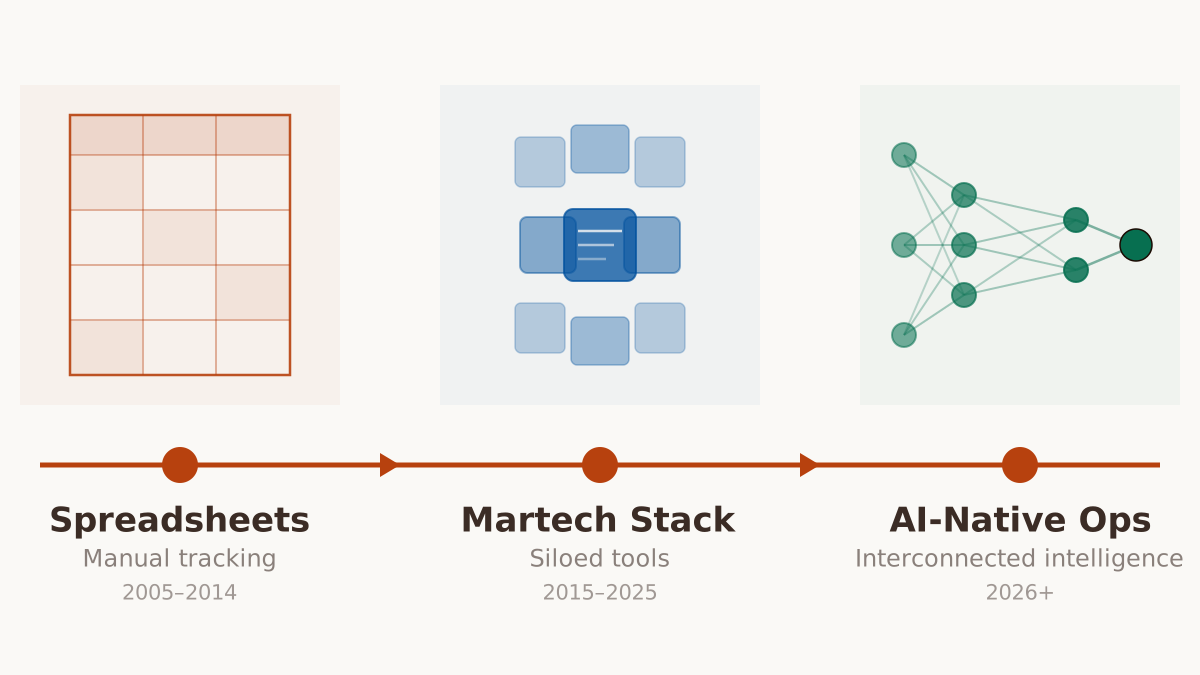
AI Marketing Operations: From Spreadsheets to AI-Native Systems
Marketing operations did not start as a discipline. It started as a problem nobody wanted to own.
Someone had to track which campaigns were running. Someone had to reconcile the lead numbers between the CRM and the email platform. Someone had to build the report that proved marketing did something. That someone became the first marketing operations professional, usually by accident.
Today the function manages technology stacks worth millions of dollars, orchestrates AI agents across channels, and sits at the intersection of strategy and execution. The path from spreadsheets to here was not linear. Each era introduced a new technology layer, and each layer exposed the limits of the previous operating model.
Here are the seven eras that shaped marketing operations into what it is today.
What’s Covered
1. The Spreadsheet Era (Pre-2005)
Before marketing automation existed, marketing operations was a spreadsheet and a shared drive. Campaign calendars lived in Excel. Lead lists were CSV exports emailed between teams. Attribution meant asking the sales rep how they heard about us.
The tools were basic: email service providers that could send bulk messages, web analytics that counted page views, and CRM systems that sales owned. Marketing had no system of record. Every campaign was a standalone project with manual handoffs at every stage.
The operational model was simple because the channel mix was simple. Print, events, early digital. When the number of channels is small, you can coordinate with meetings and emails. The spreadsheet era worked until digital channels multiplied and the volume of data exceeded what any person could track manually.
2. The Automation Era (2005 to 2012)
Eloqua launched in 1999 as the first modern marketing automation platform with lead scoring. But the real acceleration happened between 2005 and 2012. HubSpot, Marketo, and Pardot all launched in 2006, each solving a different slice of the automation problem. HubSpot introduced inbound marketing as a concept. Marketo targeted mid-market enterprises with advanced lead management. Pardot focused on Salesforce-native B2B workflows.
This era gave marketing operations its first real technology layer. Lead scoring, drip campaigns, form tracking, and basic analytics moved from manual to automated. For the first time, a marketing team could run a campaign, capture leads, score them, and pass qualified prospects to sales without a spreadsheet in the middle.
The acquisition wave confirmed the value. Oracle bought Eloqua in 2012 for $871 million. Salesforce purchased ExactTarget (which owned Pardot) in 2013 for $2.5 billion. Adobe acquired Marketo in 2018 for $4.5 billion. Marketing automation had gone from niche to infrastructure.
3. The Martech Explosion (2012 to 2018)
Scott Brinker published the first Marketing Technology Landscape in 2011. It featured 150 tools. By 2024, that number had grown to 14,106, a 27.8% increase year over year. The 2025 landscape reached 15,384 solutions across 49 categories. One hundred times the original count in 14 years.
For marketing operations teams, this created a new problem. The job shifted from running campaigns to managing an ecosystem. Every team wanted its own tool. Every tool needed configuration, integration, data mapping, and ongoing maintenance. The martech stack became a full-time job, then a full-time team.
But utilization never kept pace with adoption. Gartner found that marketers used just 42% of their stack capabilities in 2022, down from 58% in 2020. By 2023, that number dropped to 33%. Teams were paying for tools they barely touched. The martech explosion created the pile-of-parts problem: dozens of tools, none of them connected, all of them underused.
4. MOps Becomes a Discipline (2015 to 2019)
The complexity of the martech stack forced a formal response. Marketing operations stopped being something the most technical marketer handled on the side. It became a named role, then a team, then a department.
The roots go back to 2005. Gary Katz published the first article on marketing operations in MarketingProfs and chaired the first Marketing Operations Management Symposium in Los Angeles. About 70 people attended. The professional association MOCCA (Marketing Operations Cross-Company Alliance) was founded in 2006 by practitioners from Adobe, Hyperion, and Symantec. At the time, roughly 100 people globally held MOps titles.
By the mid-2010s, that number had grown by orders of magnitude. Forrester published its Marketing Operations Maturity Model, defining six core competencies: planning and budgeting, measurement and analytics, data, technology, process optimization, and functional optimization. The message was clear. MOps was no longer about keeping the tools running. It was about running marketing as a measurable, repeatable business function.
This era also produced the revenue operations (RevOps) movement. SiriusDecisions (later acquired by Forrester) championed the alignment of marketing, sales, and customer success operations under shared processes and measurement. Their research showed companies with a functioning RevOps approach achieved 19% faster revenue growth and 15% higher profitability than those without it.
5. The Data Reckoning (2018 to 2022)
GDPR went into effect in May 2018. CCPA followed in January 2020. For marketing operations, these regulations were not just legal checkboxes. They fundamentally changed how teams collected, stored, and activated customer data.
The impact was structural. Brookings Institution’s analysis examined how these regulations set benchmarks for data governance worldwide. Marketing teams shifted from collecting everything to justifying every data point. Consent management, data minimization, and right-to-deletion workflows became standard MOps responsibilities.
| Regulation | Effective | Scope | Key MOps Impact |
|---|---|---|---|
| GDPR | May 2018 | EU citizens | Explicit consent required for all data processing |
| CCPA | Jan 2020 | California residents | Right to know, delete, and opt out of data sale |
| Cookie deprecation | 2020 to 2024 | Global (browser-level) | Third-party tracking eliminated, first-party data prioritized |
This era forced marketing operations to own the data layer. CDPs (Customer Data Platforms) became the new center of the stack, replacing the marketing automation platform as the system of record. The MOps team that once managed email campaigns was now responsible for data governance, privacy compliance, and identity resolution.
6. The AI Augmentation Phase (2022 to 2024)
ChatGPT launched in November 2022. Within 18 months, every major martech vendor had added generative AI features. Content creation, audience segmentation, ad copy, subject line optimization. AI was everywhere, and it was positioned as a productivity multiplier.
McKinsey’s 2025 State of AI survey found 88% of organizations use AI, but only one-third have scaled beyond pilots. Just 6% qualify as high performers capturing significant enterprise value. The pattern was familiar: widespread adoption, limited impact. The same gap that plagued martech stacks for a decade was repeating with AI.
For marketing operations, this phase meant adding AI to existing workflows without changing the workflows themselves. Harvard Business Review’s 2025 analysis highlighted the distinction: companies need to determine whether a task requires generative AI for content creation or analytical AI for data-driven predictions. Vanguard used gen AI to increase LinkedIn ad conversion rates by 15%. The wins were real but incremental.
The limitation of this era was that AI was treated as a feature, not a foundation. Teams bolted AI onto legacy processes and measured success by time saved, not by outcomes changed.
7. AI-Native Operations (2025 and Beyond)
The current shift is different. AI is moving from a tool inside the stack to the architecture of the stack itself.
Gartner’s 2025 survey of 413 martech leaders found 81% are piloting or have implemented AI agents. But 45% say vendor-offered AI agents fail to meet their expectations. Half report their organizations lack the technical and data stack readiness required for agent deployment. The technology is ahead of the infrastructure.
McKinsey’s research on agentic AI found 62% of organizations are experimenting with AI agents, and 23% report scaling them somewhere in their enterprise. The critical insight: the traditional model where each function operates in its own silo is giving way to an integrated system where agents coordinate activities, share data, and connect the customer journey from awareness to loyalty.
For marketing operations professionals, this changes the job description. The role shifts from managing a stack of tools to architecting a system of agents. The data gravity trend reinforces this: organizations are centralizing data on cloud platforms and bringing applications to the data, rather than moving data between applications. MOps becomes the function that designs how AI agents, data, and human oversight work together.
The teams that will lead this era share one trait: clear architecture. The question has shifted from “what tools should we buy?” to “what system should we build?”
That is the through-line of every era in this evolution. Every technology breakthrough, from automation to the martech explosion to AI agents, exposed the same gap: tools without architecture create complexity, not capability. Marketing operations exists to close that gap.
Explore the AI Marketing System
→ Could AI Replace Marketing Teams?
→ The AI Marketing Framework
→ The Measurement Problem
→ Operator Logs
Frequently Asked Questions
What is marketing operations?
Marketing operations (MOps) is the function responsible for the processes, technology, data, and measurement that run marketing as a scalable business function. It covers everything from martech stack management to campaign execution workflows to performance reporting.
When did marketing operations become a formal discipline?
Marketing operations emerged as a named discipline around 2005, when Gary Katz published the first article citing MOps on MarketingProfs and chaired the first Marketing Operations Management Symposium in Los Angeles. The professional association MOCCA was founded shortly after in 2006.
How many marketing technology tools exist in 2025?
The 2025 Marketing Technology Landscape from chiefmartec.com catalogues 15,384 solutions across 49 categories. That represents 100x growth since the first landscape in 2011, which featured 150 tools.
What percentage of martech stack capabilities do companies use?
Gartner’s research shows utilization has fluctuated significantly: 58% in 2020, 42% in 2022, a low of 33% in 2023, and a partial recovery to 49% in 2025. Most organizations use less than half of what they pay for.
What is the difference between marketing operations and revenue operations?
Marketing operations focuses on the processes, technology, and data within the marketing function. Revenue operations (RevOps) expands that scope to align marketing, sales, and customer success operations under shared planning, processes, and measurement. According to SiriusDecisions, companies with a functioning RevOps approach achieve 19% faster revenue growth.
How is AI changing marketing operations in 2025 and 2026?
AI is shifting marketing operations from tool management to system architecture. Gartner found 81% of martech leaders are piloting or have implemented AI agents. McKinsey reports 62% of organizations are experimenting with agentic AI. The shift is from bolting AI onto legacy processes to designing processes around AI agents.
Go deeper
- How to Make Your Brand Readable by AI Agents
- 7 Things Marketers Need to Know About Google’s WebMCP
- Why Agentic Marketing Needs Guardrails: Bias, Hallucinations, and Oversight
- 7 Roles Marketers Must Master to Stay Relevant in the AI Agent Era
- How to Use Claude Cowork for Marketing Operations in 5 Steps (No Code Required)